
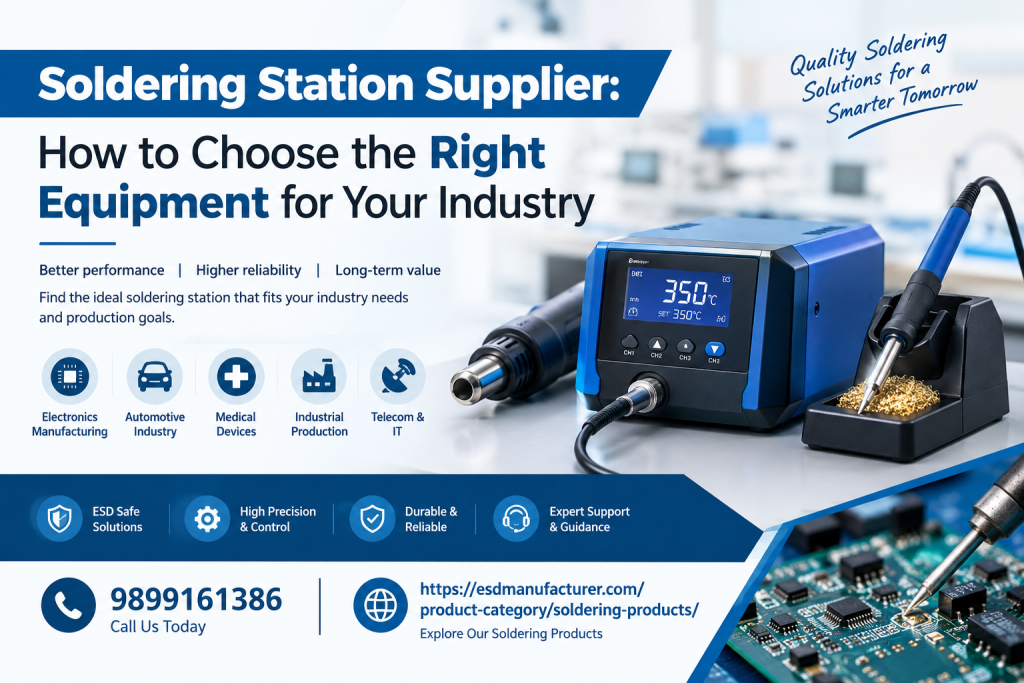
Every electronic device depends on solder joints. A weak or inconsistent joint can lead to faults, rework and wasted time. That is why the soldering station on a workbench matters as much as the skill of the person using it.
A soldering station is a temperature-controlled soldering system made up of a control unit and a connected soldering iron or handpiece. It gives technicians steady heat and adjustable settings, which helps them solder with consistency. For electronics assembly, repair and prototyping, choosing suitable equipment supports quality, safety and workplace efficiency.
This guide helps electronics manufacturers, technicians, repair professionals and industrial buyers understand soldering stations and choose the right one. It also explains what to look for in a reliable soldering station supplier.
What Is a Soldering Station?
A soldering station is a complete soldering setup designed for controlled heating. Unlike a basic plug-in iron, a station lets you set and manage the tip temperature. This matters because different components and solder types call for different heat levels.
Main Components
- Control unit: Houses the temperature controls and, in many models, the display.
- Soldering iron or handpiece: The tool held by the user. It carries the heat to the joint.
- Heating element: Generates the heat inside the handpiece.
- Temperature controls: Let the user set and adjust the working temperature.
- Compatible tips: Replaceable tips in different shapes and sizes for different tasks.
These parts work together. The control unit regulates power, the heating element produces heat, and the tip transfers it to the joint. Tips and handpieces are usually matched to the station, so compatibility is important.
Types of Soldering Stations
Available features vary by model and manufacturer. These are the main categories.
Temperature-Controlled Soldering Stations
These let the user set a target temperature and are widely used where consistent heat matters.
Digital Soldering Stations
Digital models usually show the temperature on a display and allow precise adjustment. Features differ by model.
Analogue Soldering Stations
Analogue stations typically use a dial for temperature setting. They can be simpler to operate, though they may offer fewer features.
ESD-Safe Soldering Stations
These are designed for work involving electrostatic-sensitive components. Check the product specifications to understand what protection is provided.
Specialised Stations
Some stations are made for particular applications. Examples include setups for fine-pitch work or for particular production needs. Confirm the features with the supplier.
| Station Type | General Characteristics | Typical Considerations |
| Temperature-controlled | Adjustable and regulated heat | Check temperature range and stability |
| Digital | Display and fine adjustment | Features vary by model |
| Analogue | Simple dial control | May offer fewer functions |
| ESD-safe | Intended for ESD-sensitive work | Verify specifications and grounding |
| Specialised | Built for particular tasks | Confirm suitability for your process |
Key Features to Consider When Selecting a Soldering Station
When you compare options, look closely at these points.
- Temperature stability: Consistent heat supports consistent joints.
- Adjustable temperature settings: Useful when you work with different components and solders.
- Heating performance: Consider how well the station meets your work rate. Check the datasheet for details.
- Tip compatibility: Make sure suitable tips are available for your tasks.
- Ergonomics: A comfortable handpiece reduces fatigue during long shifts.
- Safety features: Look for the safety features listed by the manufacturer.
- Ease of maintenance: Simple servicing keeps downtime low.
- Availability of replacement parts: Tips, elements and handpieces should be easy to source.
Do not assume that every station has every feature. Always confirm against the product specification.
How to Choose the Right Soldering Station for Your Industry
Requirements differ by application. Here are practical guidelines.
Electronics Manufacturing and PCB Assembly
Production environments often need stable, repeatable performance across long shifts. Consider ESD protection, ergonomics, tip availability and ease of maintenance.
Electronic Repair
Repair work involves a variety of components and board types. Adjustable temperature and a good range of tips are useful.
Prototyping
Prototyping calls for flexibility. A station that allows easy temperature changes and tip swaps can help.
Laboratories
Labs often value precision and a clean, controlled workspace. Check the station’s controls and ESD features.
Educational Institutions
Training environments benefit from stations that are easy to operate and sturdy. Safety features and simple maintenance are important where many learners share equipment.
Industrial Maintenance
Maintenance teams may need dependable equipment for varied repairs. Consider durability and the availability of replacement parts.
Why ESD Protection Matters in Soldering
Electrostatic discharge (ESD) can damage sensitive electronic components. The damage is not always visible, which makes it hard to detect. When your work involves such components, soldering equipment should fit into your wider ESD control programme.
ESD-safe soldering equipment can support that programme, but it is only one part of it. To get the intended benefit:
- Verify product specifications: Check what the supplier states about the equipment’s ESD properties.
- Check grounding arrangements: Make sure the station is properly grounded as the manufacturer instructs.
- Combine with other ESD controls: Items such as ESD mats and wrist straps are commonly used alongside ESD-safe tools.
- Follow your facility’s ESD requirements: Apply the standards and procedures relevant to your workplace.
Do not assume that a product is ESD-safe unless the supplier documents it.
The Role of Temperature Control in Soldering
Temperature control is central to good soldering. The appropriate temperature depends on factors such as the solder type, the components, the board and the joint size. Too little heat can cause poor joints. Too much heat can damage components or boards.
A station with stable, adjustable temperature control helps users work within the range suited to the job. Always follow the guidance of the solder and component manufacturers, and check the station’s rated temperature range before you buy.
What to Look for in a Reliable Soldering Station Supplier
The supplier you choose affects both the equipment and the support you receive. A dependable soldering station supplier should offer:
- Clear product information: Complete specifications you can check.
- Range of equipment: Options to suit different applications.
- Compatible tips and spares: Easy access to consumables and replacement parts.
- Technical guidance: Help in choosing the right model.
- Consistent availability: Reliable supply for ongoing needs.
- Responsive support: Clear communication before and after the sale.
You can explore the soldering range on the ESD Manufacturer website: https://esdmanufacturer.com/product-category/soldering-products/.
Common Mistakes to Avoid
- Choosing on price alone: A low price may come with limited features or support.
- Ignoring tip availability: Without suitable tips, the station is less useful.
- Overlooking ESD needs: Sensitive components need appropriate protection.
- Skipping specification checks: Confirm temperature range, power and compatibility.
- Neglecting ergonomics: An uncomfortable handpiece affects comfort and work quality.
- Not planning for maintenance: Check that spare parts are available.
Frequently Asked Questions (FAQs)
1. What is a soldering station?
It is a soldering system with a control unit and a connected soldering iron or handpiece. It allows the user to set and manage the tip temperature.
2. What types of soldering stations are available?
Common types include temperature-controlled, digital, analogue, ESD-safe and specialised stations. Features vary by model.
3. How do I choose the right soldering station?
Consider your application, temperature control, tip compatibility, ergonomics, safety features, maintenance needs and availability of spare parts.
4. Why is ESD protection important in soldering?
Electrostatic discharge can damage sensitive components. ESD-safe equipment can support an ESD control programme when properly specified and grounded.
5. Why does temperature control matter?
The right temperature depends on the solder, components and board. Stable, adjustable control helps users work within a suitable range.
6. What should I look for in a soldering station supplier?
Look for clear specifications, a suitable range, access to tips and spares, technical guidance, reliable availability and responsive support.
7. Do all soldering stations suit every industry?
No. Needs differ between manufacturing, repair, labs, education and maintenance, so choose a station that matches your application.
About ESD Manufacturer
ESD Manufacturer provides ESD-related products for industrial and electronics environments. If you are looking for a soldering station supplier or need help choosing equipment for your application, you can contact the team to discuss your requirements. For specifications and availability of any specific product, please ask the company directly.
Company: ESD Manufacturer
Address: Plot no. 174, 175, 176, 177, Udyog Vihar Extension, Ecotech-2, Greater Noida, Uttar Pradesh, India – 201306
Phone: (+91) 9899161386
Email: info@esdmanufacturer.com
Website: https://esdmanufacturer.com/