
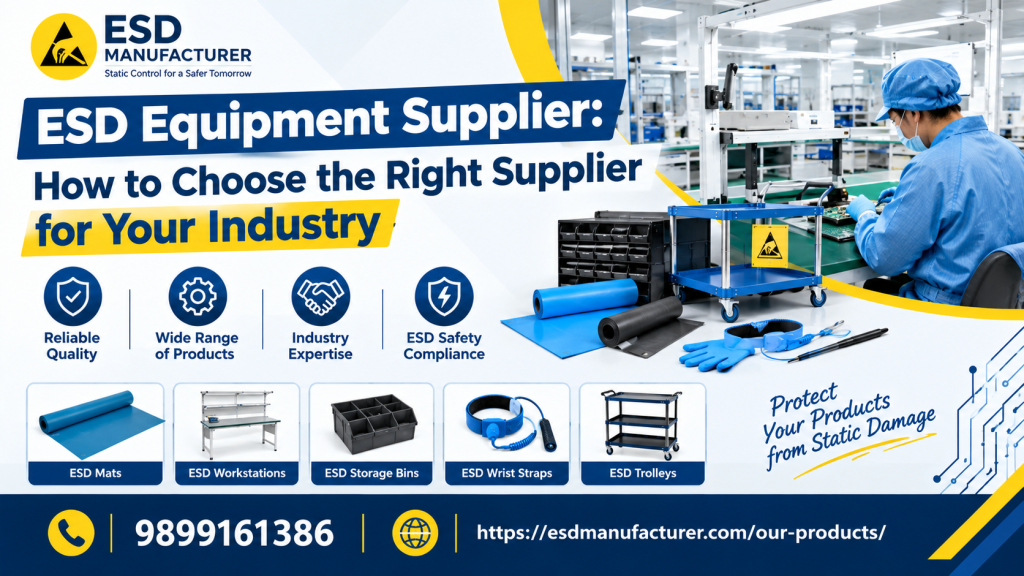
A technician slides a circuit board across a bench, and nothing seems to happen. But if static charge has built up on a person or surface and discharges through that board, the damage can be invisible. The part may fail at once or pass inspection and fail weeks later in the field.
This is electrostatic discharge (ESD): the rapid transfer of static electricity between objects at different electrical potentials. Discharges far too small to feel can still affect sensitive components. Many businesses that handle such parts build their quality systems around ESD protection, and choosing the right ESD equipment supplier is a key part of that effort.
This guide explains the common types of ESD equipment, what to look for in a supplier, how to evaluate quality and which mistakes to avoid.
Understanding ESD Equipment
ESD control is rarely about one product. It usually combines several items that work together:
- ESD mats: Work surfaces for benches and floors that support static control.
- Wrist straps: Connect the operator to ground.
- Grounding accessories: Cords, connectors and ground points that complete the path to ground.
- ESD workstations: Work areas that bring surfaces, grounding and accessories together.
- Anti-static flooring: Floor solutions that support static control across larger areas.
- Other protective equipment: Packaging, garments, storage and handling items.
Each plays a role, and none works well in isolation. A mat without a proper ground connection, for example, cannot do its job as intended.
Why Choosing the Right ESD Equipment Supplier Matters
Reliable ESD protection equipment can help reduce electrostatic risks, protect sensitive components and support workplace safety and quality control. A dependable supplier contributes in practical ways:
- Consistent product quality: Repeat orders should match earlier ones.
- Suitable solutions: Products should fit your workflow, not just look right in a catalogue.
- Technical clarity: You should be able to get clear answers on specifications and use.
- Supply continuity: Predictable availability keeps your ESD setup intact as you expand or reorder.
Poorly matched equipment can leave gaps in your protection without anyone noticing, which is why the supplier decision deserves careful thought.
Factors to Consider When Choosing an ESD Equipment Supplier
Product Quality
Ask about materials, construction and finish. Look for clear, specific descriptions rather than general claims.
Range of Available Products
A supplier with a suitable range can cover several needs at once, which helps keep your ESD setup consistent across work areas.
Industry Experience
ESD needs vary between a PCB line, a laboratory and a storage area. A supplier that understands these differences is better placed to recommend suitable products.
Technical Support
Good support before and after purchase makes selection, installation and troubleshooting easier.
Product Specifications
Compare technical details such as dimensions, materials and electrical properties between suppliers, not just prices.
Customisation Options
Some applications need non-standard sizes or configurations. Ask whether the supplier can accommodate these and what the process involves.
Pricing Transparency
Look for clear quotes that show what’s included. The lowest price isn’t always the best value if the product doesn’t suit your needs.
After-Sales Service
Responsive help with questions, replacements and reorders matters over the long term.
Supplier Comparison at a Glance
| Factor | What to Look For | Why It Matters |
| Product quality | Clear materials and construction details | Supports consistent ESD control |
| Product range | Products covering your main needs | Simplifies procurement |
| Industry experience | Understanding of your application | Helps avoid mismatched equipment |
| Technical support | Clear, responsive guidance | Eases selection and setup |
| Specifications | Detailed, comparable data | Confirms suitability |
| Customisation | Options for size or configuration | Meets non-standard requirements |
| Pricing | Transparent quotes | Avoids hidden costs |
| After-sales service | Help with questions and reorders | Supports long-term use |
ESD Equipment for Different Industries
ESD protection is relevant wherever electrostatic-sensitive components are handled:
- Electronics manufacturing: Assembly lines, test stations and packing areas.
- Semiconductor production: Environments where very sensitive devices are made and handled.
- Laboratories: Research and testing benches that handle sensitive items.
- Automotive electronics: Production and handling of electronic modules and sensors.
- Other industries: Medical devices, telecommunications, aerospace, repair services and anywhere ESD-sensitive parts are present.
The right mix of products depends on what you handle, how sensitive it is and where it’s handled.
How to Evaluate ESD Product Quality
Quality isn’t something to assume. Check:
- Product specifications: Dimensions, materials and intended use.
- Electrical properties: Resistance characteristics suited to your application, as documented by the supplier.
- Durability: How the product copes with daily use, cleaning and wear.
- Compatibility with workplace requirements: Whether it fits your benches, floors and procedures.
- Relevant industry standards: Ask which standards your facility follows, and request documentation if a supplier says a product meets any of them.
Don’t accept performance or certification claims without supporting documents. Datasheets and test reports help you verify what you’re buying.
Common Mistakes to Avoid
- Choosing on price alone: The cheapest option may not meet your requirements.
- Overlooking grounding: Many ESD products rely on a proper connection to ground.
- Ignoring a workplace assessment: Understanding where static risks exist helps you choose the right products.
- Buying without understanding your needs: Define what you handle and where before you shop.
- Skipping documentation: Verbal assurances aren’t a substitute for datasheets.
- Forgetting inspection and maintenance: Even good equipment needs regular checks.
Benefits of Working with a Reliable Supplier
A dependable supplier can simplify ESD control in several ways:
- Consistent product quality across orders.
- Appropriate product selection matched to your application.
- Technical guidance on choosing and using equipment.
- Long-term supply support for expansion and replacement.
Over time, this makes it easier to maintain a uniform ESD setup across your facility.
Why Choose ESD Manufacturer?
ESD Manufacturer is a supplier of ESD protection products. If you’re researching options, you can explore the ESD Manufacturer product range to learn more about suitable solutions for your requirements. We encourage buyers to ask detailed questions and request the information they need before deciding, including documentation relevant to your application.
Frequently Asked Questions
What does an ESD equipment supplier provide?
An ESD equipment supplier provides products used to control static electricity, such as mats, wrist straps, grounding accessories, workstations, flooring and packaging. Many also offer guidance on selecting products for particular applications.
Which ESD products are essential for an electronics workstation?
A typical setup includes a work surface such as an ESD mat, a wrist strap and grounding accessories that connect everything to a ground point. The right combination depends on your process and ESD procedures.
How do I choose the right ESD mat?
Check the material, thickness, dimensions, durability and documented electrical properties, and confirm that it suits your application and the standards your facility follows. Ask for datasheets and describe your use case to the supplier.
Which industries need ESD protection?
Industries that handle sensitive electronic components often need it, including electronics manufacturing, semiconductor production, laboratories and automotive electronics. Any environment where static discharge could affect parts may benefit.
How can I find a reliable ESD equipment supplier in India?
Look for clear product information, consistent quality, responsive communication and willingness to share documentation. Ask about technical support, customisation and delivery, and compare specifications rather than relying on price alone.
Conclusion
Choosing an ESD equipment supplier means looking beyond a product list. Weigh product quality, range, industry experience, technical support, specifications, customisation, pricing transparency and after-sales service, and check everything against your own application and procedures.
Remember that ESD control depends on a complete system, including grounding and good practice. If you’d like to discuss your requirements, we invite you to contact ESD Manufacturer for further information.
Get in Touch
ESD Manufacturer
Address: Plot No. 174, 175, 176, 177, Udyog Vihar Extension, Ecotech-2, Greater Noida, Uttar Pradesh, India – 201306
Contact Number: +91 9899161386
Email: info@esdmanufacturer.com
Website: https://esdmanufacturer.com/