
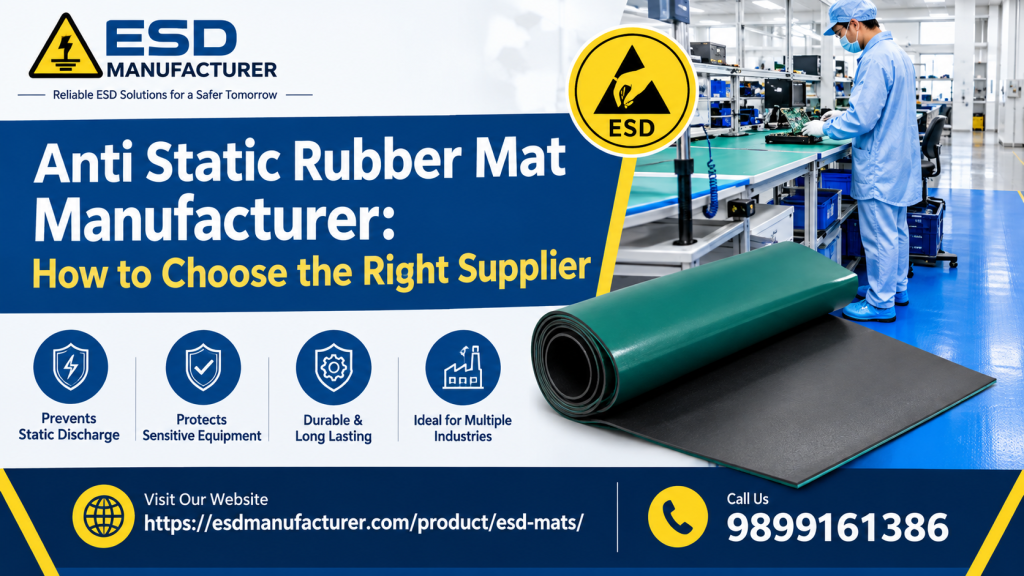
In an electronics workshop, a mat on the bench can look like a simple accessory. In practice, it’s often one of the surfaces where sensitive components are handled, placed and tested. If static electricity builds up and discharges at the wrong moment, a component can be damaged without any visible sign.
That’s why anti-static rubber mats are common in electronics manufacturing, assembly areas, laboratories and repair stations. They support electrostatic discharge (ESD) control by providing a work surface designed for static-sensitive handling. But the mat only helps if it suits your application, and that depends on choosing the right anti static rubber mat manufacturer or supplier. This guide explains what to look for.
Why ESD Control Matters
Static electricity builds up when materials touch and separate, a process called triboelectric charging. Walking across a floor, sliding a component across a surface or moving packaging can all generate charge. When that charge finds a path to ground through a component or equipment, it discharges suddenly.
Electrostatic discharge can happen at levels you can’t feel, yet still affect sensitive electronics. The result may be immediate failure or a hidden defect that appears later. That’s why many facilities build an ESD control system around their sensitive work, covering surfaces, people, packaging and handling procedures.
What Anti-Static Rubber Mats Do
An anti-static rubber mat is a work surface made from rubber-based material designed for static control. When used as part of a properly designed ESD control system, it can:
- Support ESD control: Provide a controlled surface for handling components.
- Offer a suitable work surface: Cover benches and work areas where sensitive items are placed.
- Help establish protected work areas: Contribute to an electrostatic-protected area alongside other measures.
A mat on its own does not guarantee complete protection. It works together with grounding, wrist straps, suitable footwear and good procedures.
Anti-Static, Static-Dissipative and Conductive: What’s the Difference?
These terms describe different electrical properties, and they’re not interchangeable.
| Term | General Meaning | Typical Consideration |
| Anti-static | Resists generating static charge when materials rub together | Describes low charge generation, not necessarily how charge is removed |
| Static-dissipative | Allows charge to flow away slowly and in a controlled way | Commonly used for ESD work surfaces |
| Conductive | Allows charge to flow quickly | Used in specific applications; may not suit every setting |
ESD standards define resistance ranges for these categories, and the appropriate choice depends on your application and the standards that apply to your facility. Always check the current version of the relevant standard and the product’s documented resistance values instead of relying on the name alone.
Common Applications
Anti-static rubber mats and other static control mats are used in:
- Electronics manufacturing: Production and assembly lines.
- PCB assembly: Benches where boards are handled and populated.
- Component handling: Areas where sensitive parts are sorted, stored or inspected.
- Laboratories: Testing and research benches.
- Repair stations: Service and rework areas.
- Industrial workbenches: General benches where static-sensitive items are present.
- Other suitable environments: Anywhere ESD-sensitive items are handled.
Factors to Consider When Choosing an Anti Static Rubber Mat Manufacturer
Product Quality
Look for consistent construction and finish. Ask how the supplier maintains quality from one batch to the next, so repeat orders match earlier ones.
Material Composition
Ask what the mat is made from and whether the material suits your environment, including any exposure to heat, chemicals or frequent cleaning.
Electrical Resistance Specifications
This is one of the most important details. Request the documented resistance values and check them against your facility’s requirements.
Thickness and Dimensions
Thickness affects feel, durability and how the mat sits on a bench. Make sure the size fits your workstation, and ask whether custom sizing is available if you need it.
Surface Finish
The finish affects comfort, appearance and ease of cleaning. Choose one that works for your tasks.
Durability
Consider wear from daily use, cleaning and tools. A mat that deteriorates quickly can lose its usefulness and need early replacement.
Application Suitability
A mat that works at a PCB assembly station may differ from what suits a heavy-duty industrial bench. Describe your use case to the supplier and ask for a recommendation.
Check the Documentation
Product claims should be backed by documents. Before you buy, ask for:
- Technical datasheets: Material and electrical details.
- Test reports: Evidence for stated values, where available.
- Product specifications: Dimensions, thickness and construction.
- Compliance documentation: Where the supplier states that products meet particular standards, ask for supporting papers so you can verify them yourself.
A supplier that answers openly and provides clear documents makes your evaluation easier.
A Mat Is Only One Part of the System
A properly set up ESD workstation usually includes more than a mat:
- Grounding: The mat needs to be connected to a suitable ground point as the manufacturer and your ESD procedures specify.
- Wrist straps: Connect the operator to ground.
- Compatible footwear: Helps control charge on people moving around.
- Work surfaces and accessories: Bench setups and handling tools that suit ESD practice.
- Packaging and procedures: Controlled storage and handling.
Think of the mat as one component. Without grounding and the other measures, it cannot deliver its full intended function.
How to Evaluate a Supplier
Beyond the product itself, look at how the supplier works:
- Product consistency: Do repeat orders match?
- Technical support: Can they explain specifications and help you choose?
- Custom sizing: Is it available for your benches, where applicable?
- Order requirements: What are the minimum quantities and lead times?
- Delivery expectations: Are timelines realistic and clearly communicated?
- After-sales assistance: Who do you contact with questions or replacements?
Supplier Evaluation Checklist
| What to Check | Why It Matters |
| Datasheets and test reports | Confirms the product matches your requirements |
| Resistance specifications | Determines suitability for ESD work surfaces |
| Material and thickness | Affects durability and fit |
| Customisation options | Helps with non-standard benches |
| Delivery timelines | Protects project schedules |
| Technical and after-sales support | Eases selection, setup and reordering |
Installation, Grounding and Maintenance
Follow the manufacturer’s instructions and your facility’s ESD procedures.
Installation and Grounding
- Place the mat on a clean, flat surface.
- Connect it to a suitable ground using the correct accessories, as instructed.
- Make sure the grounding connection is secure.
Cleaning
- Use cleaning methods recommended by the manufacturer.
- Avoid products that could leave residues or affect the mat’s properties.
Inspection
- Check regularly for wear, damage or contamination.
- Test the mat and grounding as part of your ESD programme, using the methods your procedures specify.
Maintenance
- Replace mats that are damaged or no longer meet requirements.
- Keep records so you can show your checks over time.
Common Buying Mistakes
- Choosing on price alone: The cheapest option may not suit your requirements.
- Overlooking resistance requirements: Always compare documented values with your needs.
- Not verifying suitability: A mat should match your environment and tasks.
- Skipping documentation: Don’t rely on verbal assurances.
- Ignoring grounding: Without it, a mat does not function as intended.
- Forgetting maintenance: Even a good mat needs regular checks.
Why Consider ESD Manufacturer?
ESD Manufacturer is a business you can contact to enquire about anti-static and ESD-related products. You can view the company’s ESD mats product page for more information, then get in touch to discuss your workplace requirements, such as the size of your benches, your working environment and the documentation you need. As with any supplier, we encourage you to ask detailed questions and request the information you need before deciding.
Frequently Asked Questions
What is an anti-static rubber mat used for?
It provides a work surface designed for static control on benches and work areas where sensitive electronic components are handled. Used with grounding and other ESD measures, it supports an electrostatic-protected work area.
How does an anti-static mat differ from a conductive mat?
The terms describe different electrical properties. Anti-static refers to low charge generation, static-dissipative allows charge to flow away in a controlled way and conductive allows charge to flow quickly. The right choice depends on your application and the relevant standards.
How do I choose the right mat?
Check electrical resistance specifications, material, thickness, dimensions, durability and application suitability. Request datasheets and test reports, and describe your environment to the supplier so they can recommend a suitable option.
Why does proper grounding matter?
A mat must be grounded as instructed to carry out its intended function. Without proper grounding, charge may not be controlled as intended. Follow the manufacturer’s instructions and your facility’s ESD procedures.
Does a mat alone guarantee ESD protection?
No. It’s one part of a complete ESD control system that also includes grounding, wrist straps, suitable footwear, handling procedures and regular checks.
Conclusion
Choosing an anti static rubber mat manufacturer is about more than picking a product from a list. Look at material, resistance specifications, thickness, dimensions and durability, ask for documentation and make sure the supplier supports you with consistent quality, delivery and assistance.
Remember that a mat works best as part of a wider ESD control system. If you’d like to discuss your requirements, we invite you to contact ESD Manufacturer for product information and assistance.
Get in Touch
ESD Manufacturer
Address: Plot No. 174, 175, 176, 177, Udyog Vihar Extension, Ecotech-2, Greater Noida, Uttar Pradesh, India – 201306
Contact Number: +91 9899161386
Email: info@esdmanufacturer.com
Website: https://esdmanufacturer.com/